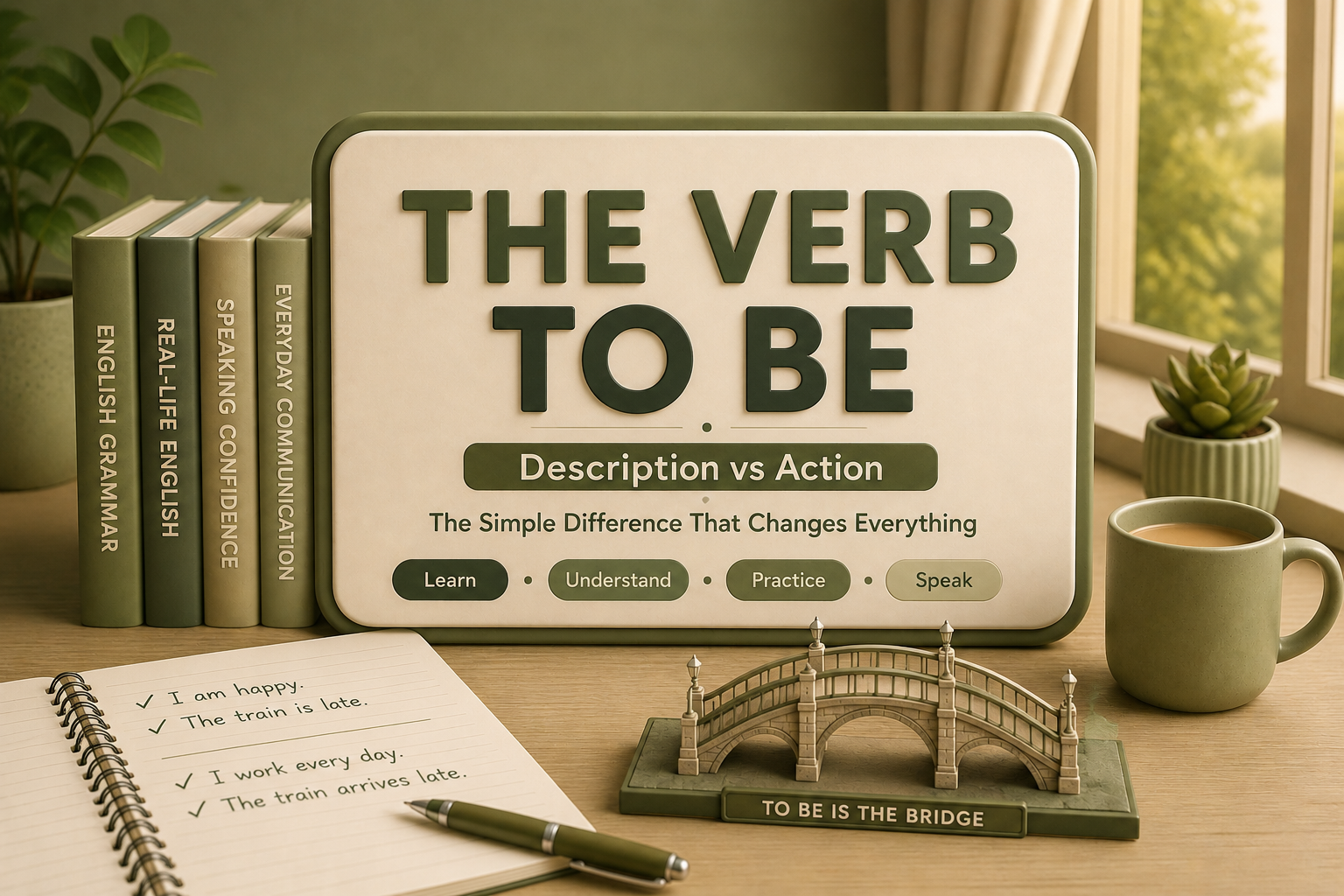
The Verb To Be
1. What is the verb “to be”?
Correct
Common mistakes
In many languages, students can say something similar to “I happy” or “She doctor.” In English, when there is no action verb, we usually need a form of to be.
2. When do we use “to be”?
Identity
I am Jennifer. He is Tom.
Age
I am 20 years old. He is 35.
Jobs
She is a doctor. They are engineers.
Nationality
She is Italian. We are South African.
Feelings
I am excited. They were nervous.
Location
The book is on the table. We were at the airport.
Descriptions
The car is fast. The weather was cold.
3. Present, Past, and Future
Present Simple: now
| Subject | To be | Example |
|---|---|---|
| I | am | I am ready. |
| You | are | You are ready. |
| He / She / It | is | She is ready. |
| We / They | are | They are ready. |
Past Simple: before now
| Subject | To be | Example |
|---|---|---|
| I / He / She / It | was | It was cold. |
| You / We / They | were | They were late. |
Future Simple: after now
| Subject | To be | Example |
|---|---|---|
| All subjects | will be | I will be ready. They will be ready. |
I was tired yesterday. I am tired now. I will be tired later.
4. First, Second, and Third Person
First Person
The speaker.
Second Person
The person you are speaking to.
Third Person
Another person, thing, or group.
5. Negative Forms and Questions
Negative
I am not tired.
He is not / isn’t here.
They are not / aren’t ready.
I was not / wasn’t hungry.
We were not / weren’t late.
She will not / won’t be there.
Questions
Am I late?
Are you ready?
Is she at home?
Was he tired?
Were they happy?
Will you be there tomorrow?
6. Main Rules: Translatable Version
Use this section when the student needs the rules in another language. The English stays simple so it translates cleanly.
7. The Two Teams in English
Team 1: Description / Information
Use to be when you give information.
Team 2: Actions
Use a normal verb when someone or something does something.
8. Wasn’t vs Didn’t
Wasn’t / Weren’t
Wasn’t = was not. Weren’t = were not. They come from the verb to be.
Use this for descriptions or information.
Didn’t
Didn’t = did not. We use it with action verbs in the past.
After didn’t, use the base verb.
Important: Do not say “didn’t was” or “didn’t were.” Use wasn’t or weren’t for the verb to be.
9. Conditional Examples
Description
Cold is information. We describe the condition inside the theater.
Action / Change
Get is an action/change. We describe what happens over time.
Practice
There are 6 exercises with 8 questions each, plus a 10-sentence conditional challenge and a final mixed test.
Exercise 1: Choose the correct form of “to be”
Exercise 2: Present, Past, or Future
Exercise 3: Description or Action?
Exercise 4: Wasn’t / Weren’t / Didn’t
Exercise 5: Correct the Mistake
Exercise 6: Build the Sentence
10-Sentence Conditional Challenge
Choose the best answer. These test the difference between information and action.